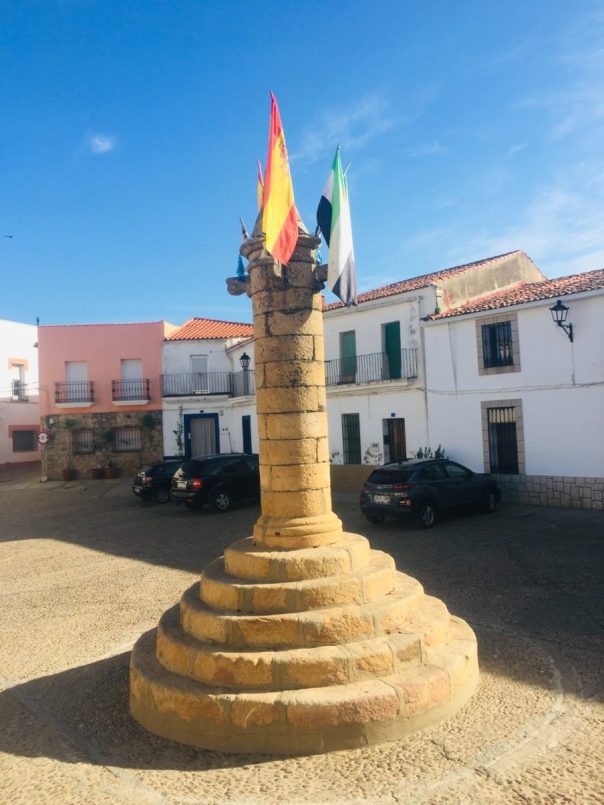
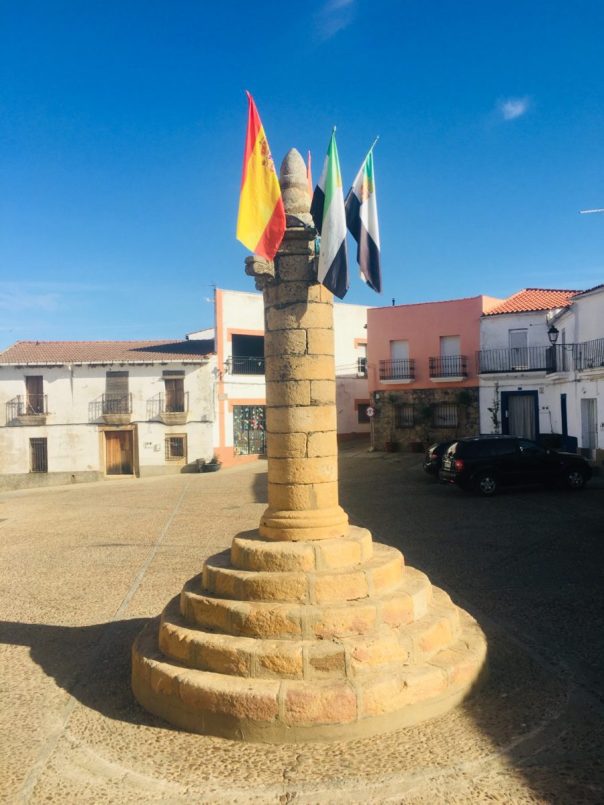
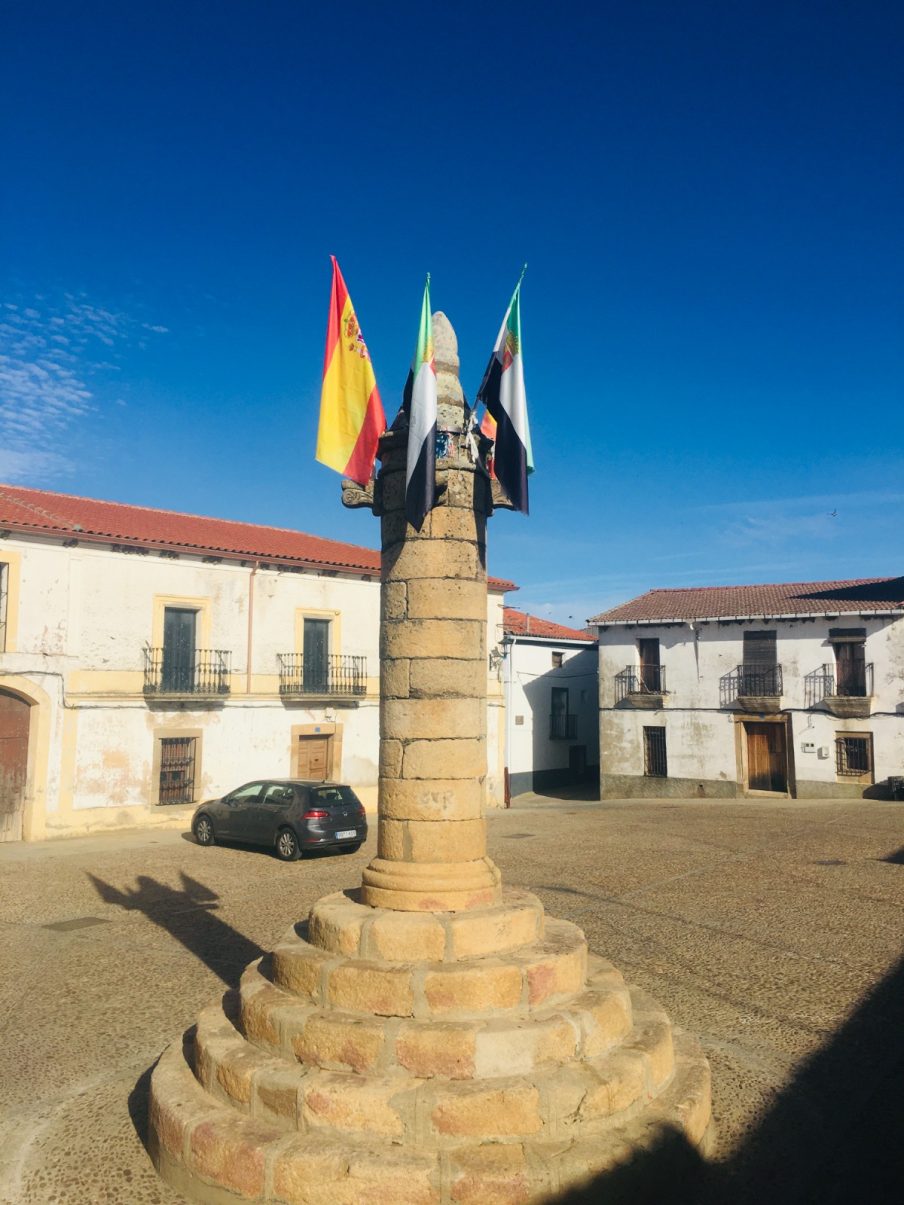
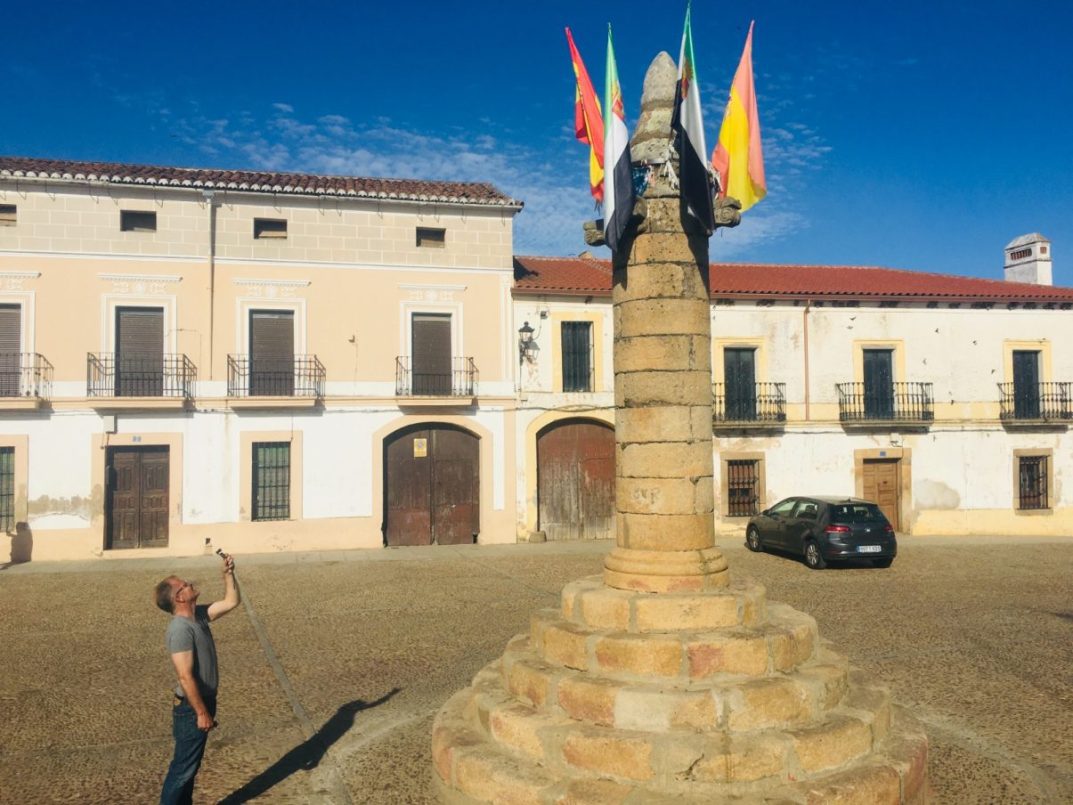
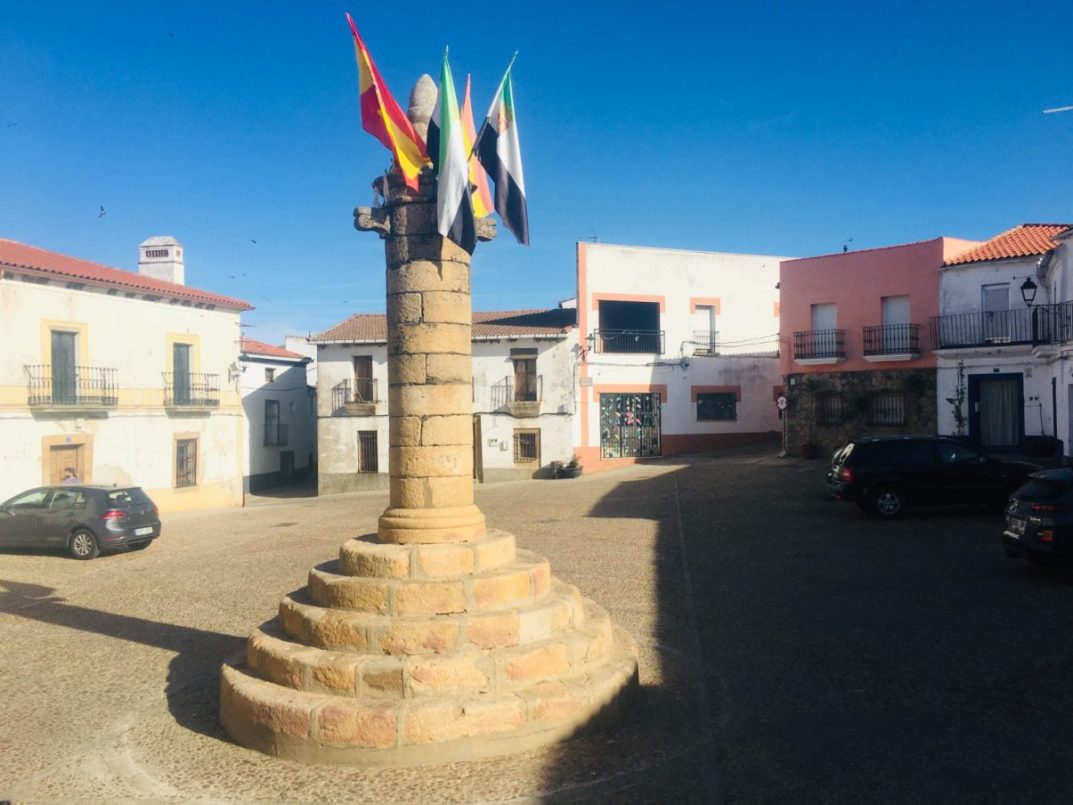
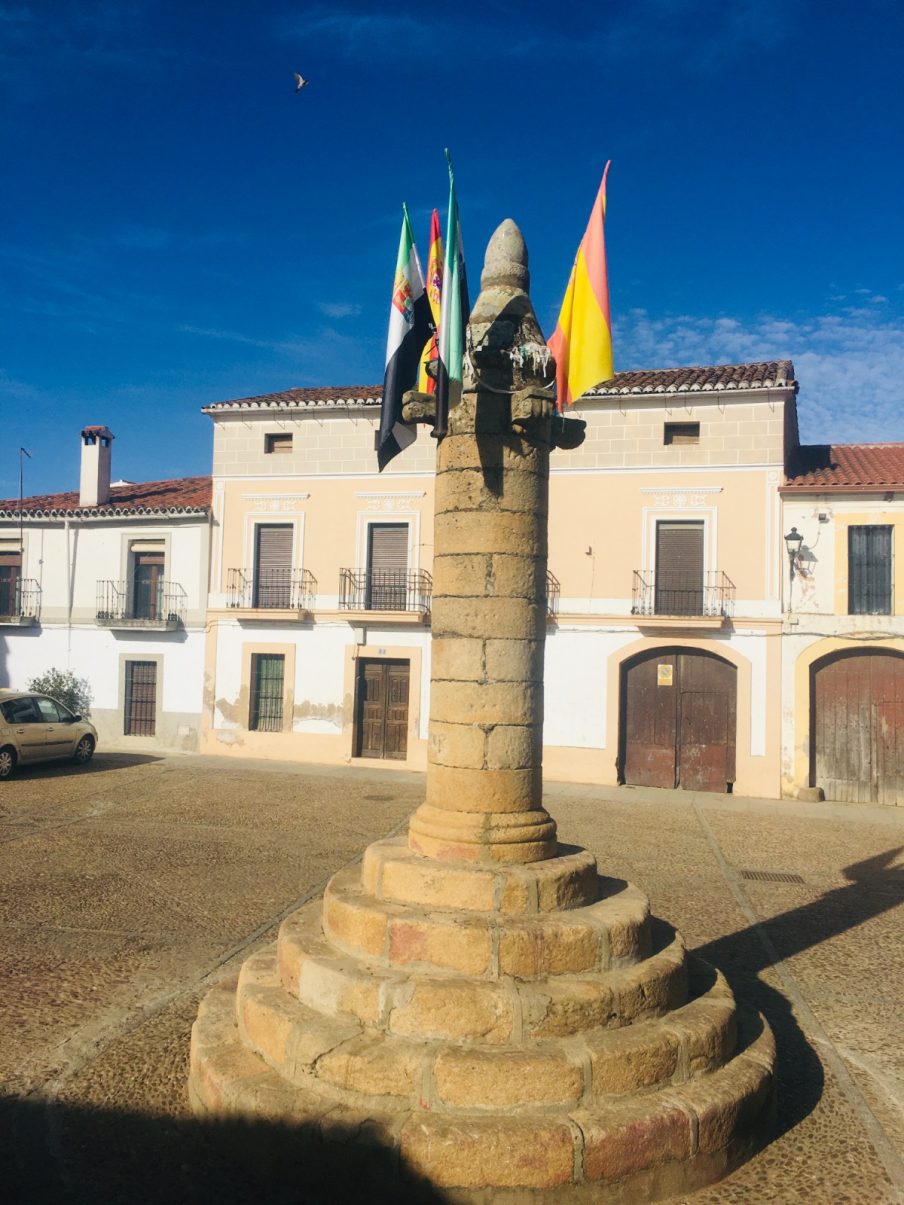
The rollo-picota stands in the center of the Plaza de España with a height of 5.60 m215, although this is not its original location, it was previously located on the Cerro de la Horca, on the outskirts of the municipality, next to the current cemetery.
VISIT
VILLAGE
Nowadays, it is common to speak indistinctly of “rollos” or “picotas” because they are expressions that refer to the same concept related to the Administration of Justice. It is called Rollo because it is a granite shaft or column, usually rounded, although not always; and it is also called Picota, because its upper part is shaped like a beak or pointed top with stone arms that protrude from the granite cylinder.
However, both expressions “rollos” or “picotas” refer not only to an architectural element that has been preserved in some of our towns, but also to a public institution such as the Administration of Justice.
There were places such as those of “realengo”, whose inhabitants depended directly on the monarch and whose social and legal status was undoubtedly the best, and therefore the people said “in realengo land make your seat, in those of seigniorial land not even for fodder”; but there were also other places that corresponded to the lords, both ecclesiastical and civil, by royal concession.
The “rollos” or “picotas” are confused in practice because they are places where justice was served. They are used as synonymous terms, but have a different origin. The “pillory” is a stone pillar intended for the public execution of criminals, i.e., intended to expose them to “public shame”. s. The “rollo”, on the other hand, although it could serve the same purposes as the pillory, was simply the expression of the lord’s power, of the lord’s authority, constituting a sign of vassalage and subordination of the inhabitants of a place.
the jurisdictional roll is the symbol of municipal power. is a cultural aspect that extends to many villages in Extremadura and Portugal. Almost all of those that remain have a historical origin linked to the beginning of the seigniories. Some were used as punishment posts, which were known as picotas, but the roll had a purely symbolic function, identifying the town with the category of Villa, either royal or lordship.
With the rollo, a model of urban planning and a system of rural agricultural exploitation began, as well as a social model, which will change substantially from one lord to another, and from one village to another.
With the Cortes de Cádiz in 1813, a movement began that sought to destroy all the rolls, as they were a symbol of vassalage. There were even laws that dictated their disappearance, but in many places, these rolls were considered municipal symbols.
Garciaz’s rollo-picota rises on a tier with five steps with a conical shape from highest to lowest, built with berrocal stone. It has a base, cylindrical shaft and capital of reduced volume of which, in its last section, there are four corbels indicating the four cardinal points, finely decorated with scrolls or geometric figures, under one of them is engraved the date of 1566, which coincides with the date of granting of gallows and pillory, knife, jail and stocks by King Philip II to the Villa de Garciaz, taking jurisdiction insignia and separating from Trujillo. A circular cornice leads to a stone cone topped with a crude figure representing an acorn – this was added in 1970, joined to the capital with lime mortar and cement-2.
Since 1963 there has been an explicit protection of these scrolls, considered important artistic and historical monuments, transmitters of the collective identity of the population. Beth then orders that they are not to be moved, nor are works or repairs to be carried out without prior authorization. In 1999, the Ministry of Culture of the Regional Government of Extremadura legislated in a similar sense, considering the rolls to be of cultural interest.