Among the residents of Garciaz who left for America in the 16th century, the figure of Diego Téllez, son of Pedro and María Díaz, stands out. He went to Mexico in 1523 and participated in the conquest of Nueva Galicia in 1531 as encomendero.

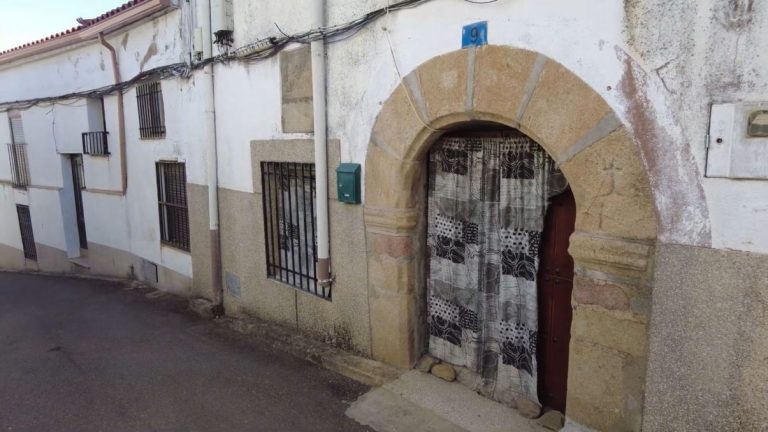
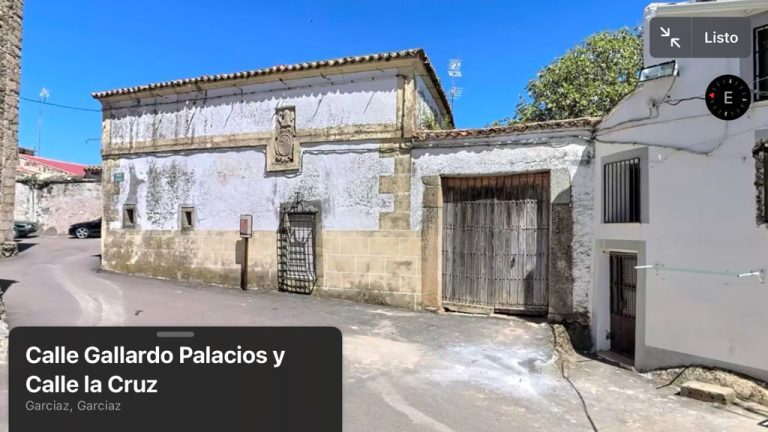
This manor house was built on the return of Diego Tellez from his American adventure, after participating in numerous successes. He returned with Hernán Cortés in 1540 and built this house next to the church, on his family’s plot of land.
Decorating one of the walls we can see the coat of arms drawn on the coat of arms, the Emperor Charles V granted it for services rendered to the kingdom. It has two quarters, one of them divided in two: a griffin, a mythological creature with the body of a lion and the head of an eagle symbolizing strength and bravery, which is said to guard the gold in the mountains. The kinship with the Altamiranos family of Trujillo, with the ten bucklers on the coat of arms, is very clear. The other half depicts a scene of conquest in which two characters appear, one of them seems to be standing on the shoulders of the other.
The building is a sample of the possibilities of the local upper-middle class. In principle it has only one habitable floor, the upper floor is used for storage, it has few windows and some of them seem to be open in more modern times.
Robust and without constructive boasts on the outside, it keeps inside the most refined artistic details, where a large courtyard surrounded by arches gives light to the rooms on the inside.
In his will, granted in 1552, he left several mandates for pious works and for the parish church of Santiago Apóstol. His son Pedro Téllez was also an encomendero in Nueva Galicia and founded the Garciaz mayorship in 1568.
It was also the residence for some time of the great artist Antonio Solís Ávila.
Diego Téllez accompanied Nuño de Guzmán, a native of Guadalajara, in the conquest of Nueva Galicia. Nuño had been appointed president of the first Audiencia, a Spanish governing body; however, he committed excesses and abuses during his tenure, on the other hand, his desire for conquest led him to undertake an expedition to the west of the country with the intention of creating a territory distinct from New Spain. Nuño de Guzmán ordered the foundation of a town in 1532, with the active participation of Diego Téllez from Garciño, which would bear the name of Guadalajara, in Nochistlán, currently Zacatecas.
The enmity between Nuño de Guzmán and Hernán Cortés provoked a threat of confrontation between the two conquistadors. Hernán Cortés had escaped the residency trial against him and had been granted permission to conduct further explorations. Finally Diego Téllez decided to return in the return expedition that had been prepared for Hernán Cortés.
Another Garcieño, Gonzalo Díaz, went to the Río de la Plata in the expedition of Ortiz de Zárate, who had gone to Spain to ask the Crown for his confirmation in the position of Adelantado. He arrived at his destination in September 1568, after enduring serious inconveniences, as the ship in which he was traveling was attacked by French pirates, who robbed him of a large amount of money and valuable clothing. In spite of all the setbacks, he managed to sign capitulations with Philip II, who granted Zarate the title of Adelantado -for him and his descendants-, of the provinces of the Río de la Plata.
Another prominent Garcieño was Francisco Díaz, who made his will in Lima in 1617. He ordered the foundation of a kinship chaplaincy in the main church of Santiago de Garciaz.
Este sitio web utiliza cookies para mejorar su experiencia mientras navega por el sitio web. De estas, las cookies que se clasifican como necesarias se almacenan en su navegador, ya que son esenciales para el funcionamiento de las funcionalidades básicas del sitio web. También utilizamos cookies de terceros que nos ayudan a analizar y comprender cómo utiliza este sitio web. Estas cookies se almacenarán en su navegador solo con su consentimiento. También tiene la opción de rechazar estas cookies. Pero la exclusión voluntaria de algunas de estas cookies puede afectar su experiencia de navegación.| Cookie | Duration | Description |
|---|---|---|
| cookielawinfo-checkbox-analytics | 11 months | This cookie is set by GDPR Cookie Consent plugin. The cookie is used to store the user consent for the cookies in the category "Analytics". |
| cookielawinfo-checkbox-functional | 11 months | The cookie is set by GDPR cookie consent to record the user consent for the cookies in the category "Functional". |
| cookielawinfo-checkbox-necessary | 11 months | This cookie is set by GDPR Cookie Consent plugin. The cookies is used to store the user consent for the cookies in the category "Necessary". |
| cookielawinfo-checkbox-others | 11 months | This cookie is set by GDPR Cookie Consent plugin. The cookie is used to store the user consent for the cookies in the category "Other. |
| cookielawinfo-checkbox-performance | 11 months | This cookie is set by GDPR Cookie Consent plugin. The cookie is used to store the user consent for the cookies in the category "Performance". |
| cookielawinfo-checkbox-performance | Set by the GDPR Cookie Consent plugin to record the user consent for the cookies in the "Performance" category. | |
| CookieLawInfoConsent | Records the default button state of the corresponding category & the status of CCPA. It works only in coordination with the primary cookie. | |
| elementor | This cookie is used by the website's WordPress theme. It allows the website owner to implement or change the website's content in real-time. | |
| viewed_cookie_policy | 11 months | The cookie is set by the GDPR Cookie Consent plugin and is used to store whether or not user has consented to the use of cookies. It does not store any personal data. |
| Cookie | Duration | Description |
|---|---|---|
| _ga | The _ga cookie, installed by Google Analytics, calculates visitor, session and campaign data and also keeps track of site usage for the site's analytics report. The cookie stores information anonymously and assigns a randomly generated number to recognize unique visitors. | |
| _ga_3JH8W21W66 | This cookie is installed by Google Analytics. | |
| CONSENT | YouTube sets this cookie via embedded youtube-videos and registers anonymous statistical data. |
| Cookie | Duration | Description |
|---|---|---|
| VISITOR_INFO1_LIVE | A cookie set by YouTube to measure bandwidth that determines whether the user gets the new or old player interface. | |
| YSC | YSC cookie is set by Youtube and is used to track the views of embedded videos on Youtube pages. | |
| yt-remote-connected-devices | YouTube sets this cookie to store the video preferences of the user using embedded YouTube video. | |
| yt-remote-device-id | YouTube sets this cookie to store the video preferences of the user using embedded YouTube video. | |
| yt.innertube::nextId | This cookie, set by YouTube, registers a unique ID to store data on what videos from YouTube the user has viewed. | |
| yt.innertube::requests | This cookie, set by YouTube, registers a unique ID to store data on what videos from YouTube the user has viewed. |
| Cookie | Duration | Description |
|---|---|---|
| cookielawinfo-checkbox-imprescindibles | No description | |
| wp-wpml_current_language | No description available. |